
How Public Speaking Helps Kids Build Confidence

Updated: Jul 21

Confidence in children does not usually appear out of nowhere. It is built step by step through experience. A child becomes more confident when they try something challenging, improve over time, and realize they can handle more than they thought.
That is exactly why public speaking can be so powerful.
When kids learn to speak clearly, share their ideas, and present in front of others, they are not just building communication skills. They are building self-belief. They start to trust their voice, feel more comfortable being seen and heard, and carry that confidence into school, friendships, and everyday life.
Here is how public speaking helps kids build confidence in a real and lasting way.
Confidence grows through action
One of the biggest myths about confidence is that kids need to “feel confident” before they speak up.
That is backwards.
In reality, confidence usually comes after action, not before it. A child may feel nervous before introducing themselves, answering a question, or giving a short speech. But after doing it once, then again, then again, they begin to realize something important: “I can do this.”
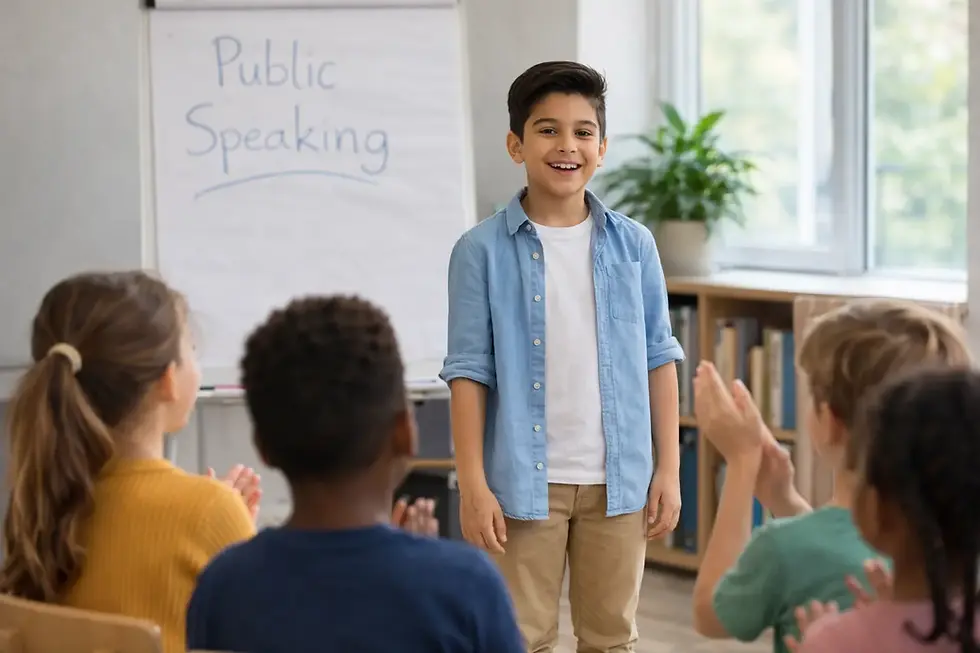
Public speaking gives kids repeated opportunities to practise speaking in a structured and supportive environment. With each small success, confidence becomes less of a mystery and more of a habit.
That matters because many kids struggle silently. They may know the answer in class but hesitate to raise their hand. They may have great ideas, but hold back in group settings.
Public speaking helps close the gap between what they know and what they are willing to say out loud.

Kids learn to trust their own voice
A confident child is not necessarily the loudest child in the room. Confidence often looks much quieter than that.
Sometimes it looks like speaking clearly when asked a question. Sometimes it looks like making eye contact. Sometimes it looks like sharing an opinion without apologizing for it first.
Public speaking helps children recognize that their thoughts matter and that other people will listen when they speak with clarity and purpose. Over time, they begin to trust their own voice.
One student’s journey shows how public speaking can transform much more than presentation skills. Read How Public Speaking Changed My Life to discover how finding his voice affected his confidence, school experience, relationships, leadership skills, and future goals.
This is especially valuable for kids who are thoughtful, reserved, or hesitant in new situations. They do not need to become performers. They need to become comfortable expressing themselves. That is a much more useful goal, and frankly, a much more realistic one.
Public speaking improves more than speeches
Parents often think public speaking only matters for presentations or competitions. It does help in those settings, of course, but the benefits go much further.
When kids become stronger speakers, they often become more confident in everyday situations, such as:
participating in class
asking teachers for help
introducing themselves to new people
sharing ideas in group work
handling interviews or auditions
standing up for themselves respectfully
That is where the real value shows up.
A child who can speak with confidence is often better equipped to navigate school, social situations, and future opportunities.
Public speaking is not just about standing at the front of a room. It is about learning how to handle moments where communication matters.
And those moments pile up quickly as kids grow.
They become more comfortable making mistakes
This is one of the most underrated benefits.
Many kids avoid speaking because they are afraid of getting something wrong. They worry about forgetting their words, sounding awkward, or being judged. That fear can chip away at confidence over time.
Public speaking helps kids face that fear in a healthy way.
They learn that mistakes are normal. They learn that forgetting one line does not mean failure. They learn how to pause, recover, and keep going. That kind of resilience is a major part of confidence.
A child who learns, “I can make a mistake and still be okay,” is often far more confident than a child who is simply trying to be perfect.
Perfection is a terrible confidence strategy. It is exhausting, and kids figure that out fast.
Public speaking helps kids prepare for the future
The ability to communicate clearly becomes more important as children get older.
In elementary school, it helps with classroom participation and presentations. In middle school and high school, it supports leadership, teamwork, interviews, and academic performance. Later, it becomes valuable in university, work, and professional life.
Kids who develop strong speaking skills early often have an advantage because they are more prepared to express ideas, ask thoughtful questions, and present themselves well under pressure.
That does not mean every child needs to love the spotlight. It means every child benefits from being able to communicate with confidence when it counts.
Public speaking helps build that foundation early, before hesitation becomes a habit.
A supportive environment makes a big difference
Not every child builds confidence in the same way or at the same speed.
Some children jump in quickly. Others need more encouragement, more practice, and more time. That is normal.
What matters is the environment.
Kids build confidence best when they are challenged without being overwhelmed. They need structure, encouragement, and clear feedback. They need a place where they can practise, improve, and feel proud of their progress.
That is one reason public speaking courses can be so effective. In the right setting, children are not just told to be more confident. They are given the tools and repetition
needed to actually become more confident.
That is the difference. Encouragement matters, but practice changes behaviour.
Final Thoughts on Building Confidence
So, how does public speaking help kids build confidence?
It helps them speak up when they would normally stay quiet. It helps them organize their thoughts, trust their voice, and recover from mistakes. It gives them real experience doing something hard and getting better at it.
Confidence is not built through one pep talk or one good day.
It is built through practice, progress, and proof.
Public speaking gives kids that proof.
At Stand Up and Speak, our goal is not to create perfect performers. It is to help children become more confident communicators who can express themselves clearly in school, in social settings, and in life.
That is a skill worth building early.


Comments