
How Summer Public Speaking Camps Build Confidence Before School Starts

Updated: Jul 24

Parents often spend the final weeks of summer getting ready for the school year. They buy supplies, review schedules, organize transportation, and help children return to a more consistent routine.
Those preparations matter. But another kind of school readiness is easy to overlook: the confidence to speak.
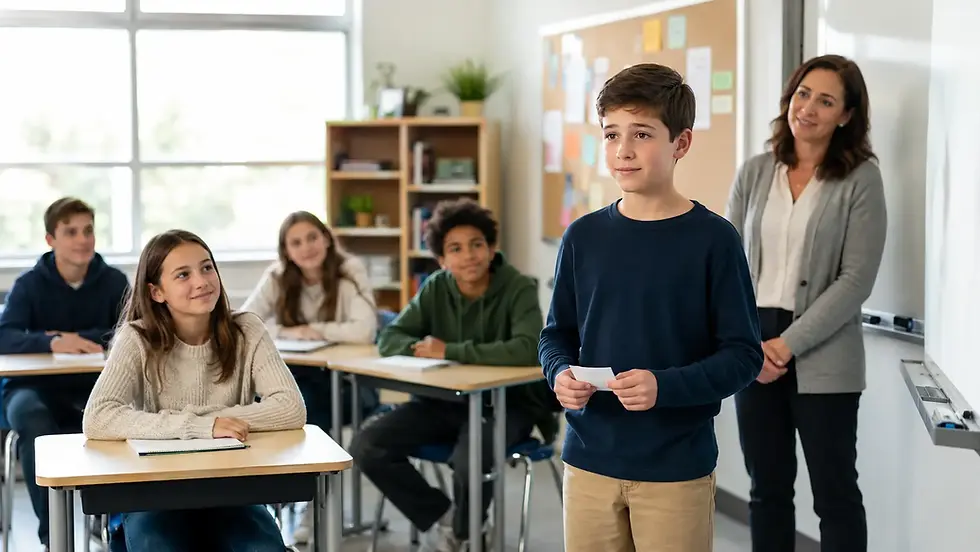
A student can understand the lesson and still hesitate to raise a hand, present their work, or explain an idea during a group project. A summer public speaking camp gives kids and teens time to practice these situations before the school year begins.
Instead of waiting for the first presentation, class discussion, interview, or group assignment to become the practice session, students can build useful communication habits in advance.
The goal is not to turn every child into the loudest person in the room. It is to help each student become more comfortable organizing ideas, using their voice, listening to others, responding to questions, and speaking clearly when it matters.
Why Summer Is a Good Time to Build Speaking Confidence
During the school year, communication challenges often come with grades, deadlines, classmates, and the fear of making a mistake.
Summer creates a different environment. Children can try a speaking activity, receive feedback, adjust, and try again without the same academic pressure.
That matters because confidence does not usually develop after a single successful speech. It grows through repeated experiences that teach a student, "I can handle this."
A child might begin by introducing themselves to a small group. Later, they may tell a short story, explain an opinion, participate in an impromptu activity, or present a prepared speech. Each step makes the next one more familiar.
This is especially helpful before school starts. The student returns to class with recent experience speaking in front of others, rather than hoping they will suddenly feel confident when called on.
Public Speaking Camp Is About More Than Speeches
The phrase “public speaking camp” can sound as though children will spend the week memorizing formal speeches and standing behind a podium.
A strong program should be much broader than that.
At Stand Up and Speak summer camps, activities include public speaking, impromptu speaking, speech writing, presentation skills, conversation skills, leadership training, games, and video evaluations. Programs are offered for kids and teens in age-appropriate groups, with half-day and full-day options available.
These activities help students organize their thoughts, listen before answering, use examples, project their voices, manage their pacing, make eye contact, participate in discussions, receive feedback, work with peers, and recover from mistakes.
Those skills show up in daily life far more often than in formal speeches.
The School-Year Confidence Advantage
The first weeks of school bring many small moments for speaking.
Students introduce themselves to new teachers and classmates. They answer questions, ask for clarification, join group discussions, explain summer experiences, and begin working with new teams.
Older students may interview for clubs, leadership positions, volunteer roles, or part-time jobs.
A child who has practiced speaking during the summer is not guaranteed to feel completely calm in every situation. That is not a realistic promise.
What they can have is a process.
They can pause before answering. They can start with one clear point. They can support the point with a reason or example. They can speak loudly enough to be heard. They can look up from their notes. They can recover if they lose their place.
Practical skills reduce uncertainty. A student who knows what to do next is less likely to feel trapped by nerves.

Summer Camps Help Kids Organize Their Ideas
Many children do not struggle because they lack ideas. They struggle because the ideas arrive all at once.
A teacher asks a question, and the student begins answering before deciding on the main point. They start with one thought, jump to another, add an unrelated example, and then lose confidence because the answer isn't coming out the way they intended.
Public speaking practice gives students simple structures they can use.
For example:
State the main idea.
Give one reason.
Add an example.
Finish with a clear sentence.
That structure can be used in a classroom answer, a presentation, an interview, a debate, or a conversation with an adult.
The student does not need to memorize every word. They need a reliable path through the answer.
When students understand how ideas fit together, they can express them more clearly in speaking and writing.
Practice Helps Students Manage Nerves
Nervousness is not proof that a child is bad at public speaking.
It is a normal response to being watched, evaluated, or asked to perform. Even experienced adults can feel a racing heart, dry mouth, shaky hands, or a blank mind before an important presentation.
The useful goal is not to eliminate every nerve. It is to help students function even when nerves appear.
Camp activities can teach students to breathe steadily, prepare a clear opening, focus on the message, slow down, use notes effectively, clarify questions, and continue after a mistake.
That last skill is important.
Many students fear public speaking because they believe one mistake will ruin the entire presentation. Practice helps them discover that a missed word, awkward pause, or forgotten sentence is usually recoverable.
Once students have successfully recovered several times, mistakes feel less dangerous.
Quiet, Shy, and Outgoing Kids Can All Benefit
Public speaking is sometimes treated as an activity for naturally outgoing children.
That misses the point.
Quiet students can become excellent speakers because they often observe closely, prepare thoughtfully, and choose their words carefully.
Shy students can become more comfortable expressing ideas without changing their personality. Energetic students can learn pacing, listening, and organization. Already-confident students can refine their delivery, strengthen their arguments, and become more aware of their audience.
The objective is not to produce one type of speaker.
It is to help each child communicate more effectively in their own style.
For one student, progress may mean speaking loudly enough to be heard. For another, it may mean pausing, making eye contact, or giving a clearer example. A supportive camp recognizes that progress looks different for each student.
Better Listening Creates Better Speaking
Public speaking is not only about talking.
Students also need to listen to instructions, questions, feedback, and other points of view. In group activities, they need to understand what has already been said before adding their own idea.
During questions and answers, they need to respond to the real question rather than the one they expected.
Public speaking practice can improve attention, response skills, classroom participation, debate, and everyday communication. Students begin to understand that confident communication includes knowing when to speak, when to pause, and how to build on another person's idea.
Listening also helps children become more respectful communicators.
They learn that confidence is not the same as dominating a conversation. Strong communication includes knowing how to disagree without being disrespectful and recognizing when another person has made a useful point.
These habits matter in classrooms, friendships, teams, leadership roles, and family conversations.
Camp Gives Students Real Speaking Repetition
Children do not become comfortable speaking by hearing someone explain public speaking for several hours.
They need to speak.
A useful summer camp should give every student regular opportunities to participate. That can include short introductions, stories, impromptu prompts, small-group activities, formal presentations, debates, interviews, and team exercises.
The repetition should be structured, not punishing.
Students need feedback they can understand and use. "Be more confident" is not useful feedback.
"Slow down after your opening sentence," "look at three people before checking your notes," or "give one example after your main point" gives the student something specific to practice.
Over time, those small adjustments add up.
The student begins to understand that public speaking is not mysterious. It is a group of skills that can be practiced one at a time.
Communication Skills Support Long-Term Readiness
Parents may enroll a child in an upcoming school presentation, but the value of communication practice extends beyond that.
The National Association of Colleges and Employers includes communication among its core career-readiness competencies. Its definition emphasizes clear, organized communication; active listening; verbal and nonverbal communication skills; and asking appropriate questions.
Children still deserve to learn, play, and enjoy the summer. At the same time, the ability to explain an idea, listen carefully, and participate in a group becomes more valuable as students grow.
Camp can begin that development in an age-appropriate way.
What Parents Should Look for in a Summer Public Speaking Camp
Not every camp will suit every child.
Parents should look beyond the program name and ask what students will actually do.
How Often Will Each Child Speak?
A child cannot build speaking confidence by watching the instructor talk. Ask whether students receive daily opportunities to present, respond, discuss, or participate.
Are Activities Appropriate for the Child's Age?
A five-year-old and a seventeen-year-old should not be taught in the same way.
Younger children may benefit from storytelling, games, voice practice, and short presentations. Teens may need more advanced work in debate, interviews, persuasion, leadership, and impromptu speaking.
How Is Feedback Delivered?
Feedback should be constructive, specific, and encouraging. Children need to know what they did well and what to work on next.
Is the Environment Supportive?
Students should be challenged without being embarrassed. Mistakes should be treated as part of learning, not as entertainment for the group.
Is the Program Active?
Look for speaking games, discussions, team activities, presentations, question-and-answer practice, and real opportunities to communicate.
Some students may want to continue after summer through Confident Communicator courses, competitive speaking, private coaching, or live online options. Stand Up and Speak currently offers each of these paths for kids and teens.
How Parents Can Reinforce the Skills at Home
Parents do not need to turn the dinner table into a speaking exam.
Ask your child to explain a favorite part of camp. Ask why they chose a certain topic. Let them tell a story from beginning to end.
Encourage them to order their own food, ask a store employee a question, or introduce themselves to an adult.
When giving feedback, praise the behavior rather than offering only a broad compliment.
Instead of "You were amazing," try:
“Your opening sentence was clear.”
“You kept going after you forgot a word.”
“That example helped me understand your point.”
“You spoke loudly enough for everyone to hear.”
“You listened carefully before answering.”
Specific feedback helps students recognize what they can repeat.
Parents can also use low-pressure games at home. Simple public speaking games can help students slow down, organize their thoughts, and respond more clearly without making the practice feel like another homework assignment.
Confidence Before School Does Not Mean Perfection
A successful camp does not need to produce a flawless final speech.
The more meaningful result may be a student volunteering without being pushed, recovering after losing their place, making eye contact, answering a question, or speaking to an instructor with more comfort.
Those changes can make the return to school feel different.
The student may still feel butterflies before a presentation. But they have practiced what to do with them.
Choosing the Right Next Step
A summer public speaking camp can be a strong starting point because it provides students with focused practice in a supportive setting.
Some children will use camp to prepare for school. Others may discover an interest in storytelling, debate, or leadership, or benefit from continued weekly or one-on-one practice.
Parents can explore Stand Up and Speak summer camps for current camp options, or review the broader Kids and Teens Public Speaking Courses to compare Confident Communicator, competitive, private coaching, and online paths.
The current summer camp page includes age-based programs, speaking and leadership activities, and July and August camp options.
The right choice depends on the child's age, comfort level, goals, and preferred learning environment.
Final Thoughts: Building Confidence Before School Starts
Summer gives children room to practice communication without waiting for a high-pressure school moment.
Through public speaking activities, students can organize ideas, use their voices, listen, respond to questions, manage nerves, and recover from mistakes.
The goal is not perfection.
It is preparation.
A student who has practiced is more likely to trust that they can handle a classroom answer, presentation, group project, or new social situation. Confidence grows from experience, not from being told to “just be confident.”
With structure, repetition, encouragement, and the right environment, kids and teens can
become clearer, calmer, and more capable communicators before the first school bell rings.
Not sure whether camp, a weekly course, or private coaching is the right fit? Explore Stand Up and Speak programs for kids and teens.

Frequently Asked Questions
Are Summer Public Speaking Camps Good for Shy Kids?
Yes. A supportive public speaking camp can give shy or quiet children low-pressure opportunities to practice speaking in manageable steps.
The goal should not be to change the child’s personality. It should be to help them feel more comfortable expressing ideas, asking questions, and participating.
At what age should children start public speaking?
Children can begin practicing age-appropriate public speaking skills at a young age.
Younger students can work on storytelling, voice projection, listening, and short introductions. Older children and teens can develop presentation, debate, interview, leadership, and impromptu speaking skills.
What Happens at a Public Speaking Summer Camp?
Activities may include short speeches, storytelling, speaking games, impromptu prompts, speech writing, presentation practice, conversation skills, leadership exercises, group discussions, feedback, and video evaluation.
The exact activities should be adapted to the students’ ages and experience levels.
Can Public Speaking Camp Improve Confidence at School?
It can help. Students practice skills that apply directly to classroom participation, presentations, group projects, discussions, interviews, and conversations with teachers.
Confidence grows when these situations become more familiar, and students know how to respond.
How Long Does It Take for a Child to Become a More Confident Speaker?
There is no single timeline.
Some children show visible improvement within a few days, while others need consistent practice over weeks or months. Progress depends on the child's starting point, comfort level, practice opportunities, and learning environment.
Is Public Speaking Only Useful for Presentations?
No.
Public speaking training also supports everyday communication, listening, organization of ideas, teamwork, leadership, interviews, debate, and the ability to think and respond under pressure.
What Should Parents Look for in a Public Speaking Camp?
Look for age-appropriate groups, regular speaking opportunities, supportive instructors, constructive feedback, active learning, small enough groups for participation, and a clear approach to helping nervous or inexperienced students.
What Can Children Do After Summer Camp?
Students can continue with weekly Confident Communicator courses, competitive speaking and debate, private coaching, or online programs.
The best next step depends on whether the child needs general confidence practice, an advanced challenge, or targeted preparation for a specific event.


Comments